
How to Read Scholarly and Peer-Reviewed Articles: A Step-by-Step Guide
This article is also available in Spanish [Lee la versión en español aquí]

Have you ever read through a scholarly article and felt completely lost and confused? Did you scroll through page after page of dense technical jargon and wonder how anyone can actually understand this stuff? Reading academic articles for beginners, students, and early researchers academic writing can feel like a foreign language made more difficult to understand with the added statistics. It can make scholarly publications seem impossible to get through.
Experienced researchers do not have these struggles as they read through scholarly articles differently than most students or others new to scholarly sources. Instead of starting on the first page and slowly moving through each section to the end, experienced readers apply a strategic approach to better understand academic writing.
In this article we will guide you through how to read a scholarly article. While there are many strategies to engaging with academic writing, these techniques can help you understand the big picture quicker and move on to deeper dives into the subject you are researching.
What Makes an Article Scholarly and Peer Reviewed?
A scholarly or academic article are most easily identified as research studies that are published in professional journals. Before being published and listed in research databases these publications must go through a process called peer review. During peer review a set number of experts in the field are asked to carefully review and evaluate the study. This is to make sure the research approach is appropriate, the methodologies are sound, the data is accurate, and that the results, analysis, and conclusions make sense.
Due to the rigor of evaluation, peer-reviewed articles are considered as some of the most realizable sources of information. Whether in clinical research, academia, or industry applications, peer reviewed research studies are the backbone of evidence-based practice. Learning how to find them in academic databases such as PubMed and Google Scholar is important for supporting research activities. Learning how to read them effectively and efficiently will be a skill that will benefit you well beyond writing assignments. If you are new to scholarly sources and want to understand the difference between peer-reviewed articles and other types of academic publications, see our guide to scholarly sources and academic articles.
Understanding the Structure of a Research Article
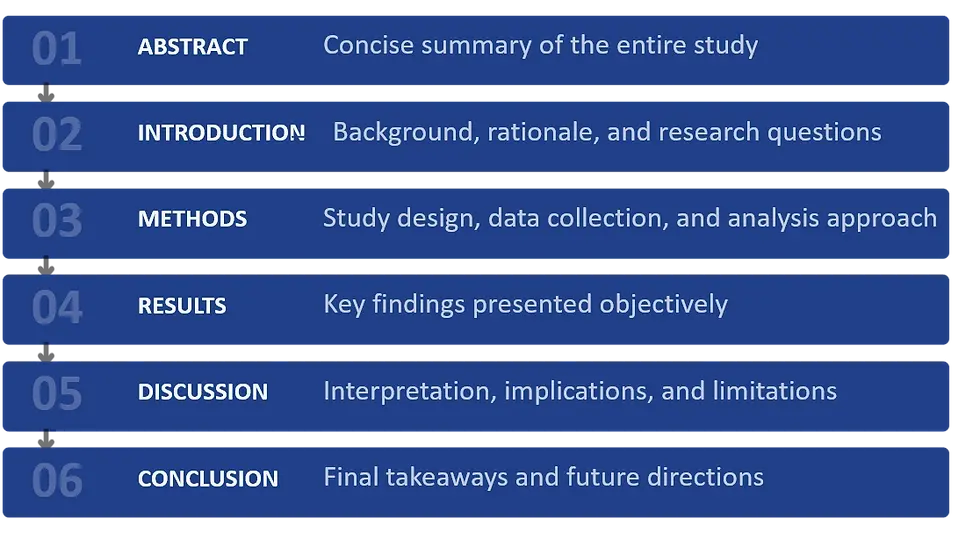
A common mistake that can make reading scholarly articles more stressful is trying to read the article like a book. Inexperienced readers may not know how to read a research paper and might try to start reading the article from the beginning and going over each word until the end. Academic papers are not written in narrative structures and would be treated more like reports with a common structure. Understanding this structure can make digesting the publication much easier.
There is not a standard structure to all scholarly writings but there are common similarities. Most scholarly articles will contain an abstract that summarized the entire study. After the abstract will typically be an introduction that provides background information and past research related to the research question of the article. A methods section is pretty standard which describes how the study was conducted and what statistics were applied to the results during analysis. A results section typically summarized the findings with graphics and explanation. Discussion and/or conclusion sections present the findings and the implications they have to the field while typically providing areas of future research.
While the structure for different articles may not be exactly the same, they typically have a similar pattern. Once you are able to recognize the pattern and the different information provided in the different sections it makes navigating the article much easier and prevents a readers from getting lost in the technical details.
A Smarter Way to Read Academic Articles

Here’s the secret most people are not regularly taught, you don’t need to read every article line by line. There are more efficient ways on how to understand research articles and evaluate them.
One way to approach the article is by applying academic reading strategies like skimming. This is easily done by reviewing the title, read the abstract, ad reviewing the section headings. After that if the study still seems relevant move onto the discussion and conclusion section to understand the authors main findings and why the study matters. This can help you grasp the big picture of the study much quicker.
If the study outcomes are still relevant after that quick review take a look at the tables, charts, and other figures and graphics. The visual data and related captions can help communicate the study outcomes quicker than text.
After all this review if the study seems relevant to your research or project you can go back and read specific sections in detail. This approach can help you filter out unrelated studies and drastically decrease your reading time without sacrificing research comprehension.
How to Take Meaningful Notes While You Read
Have you ever looked back at a page you just read and found the whole thing highlighted but you don’t recall what or why you highlighted? Instead of doing this, a better approach for retention is summarizing key ideas in your own words. Look for the key components or sections of the article and make notes that you can refer to in the future to help you understand why this study is important to your work. Here are some items to make notes on:
Research Question - Ask what is the author(s) investigating or what are they out to prove.
Introduction/Literature Review - This provides a summary of the background research in related areas, research gaps, and context for the presented study.
Methodology - The research methodology helps explain the study design and what was done, why it was done, and how it as evaluated. This section can help you prepare established methods for future studies.
Results - The findings and results will be presented in one section. This usually includes graphs, charts, other graphics, and brief descriptions of what the study results were.
Discussion/Conclusion - In this section you will find an overall summary of the study. It will provide explanation for the results, what they mean, and implications for relevant applications. This provides the interpretation of the results with identified limitations and calls for future research.

Understanding general article structures can help you capture important information as you are conducting your research. Focus on capturing the research questions, how the results and findings are important to the research goals, and how the findings are important to your research and critical appraisal of the study design and results.
Using digital tools can help you organize your notes by article and subject in an annoted bibliograpy, making the writing and its action process much easier. Reference and citation managers like Zotero can allow writers to easily organize and store relevant references. Coupled with thoughtful note taking you can vastly improve your research workflow with a reference management tool.
Learning to Think Critically About Research
Digesting scholarly articles is more than just understanding what the author wrote but also about evaluating the quality of the research presented. As you read through different publications there are some simple but powerful peer reviewed article tips and questions you can ask. As you read through articles you can improve your critical analysis by evaluating the following:
Based on the background information and literature how does the study contribute to the body of knowledge in that field or area of study? Does it contribute anything new?
Take time to evaluate the evidence. Review dates, acknowledgments, sources, and other information to determine if the background information and study design are reliable.
Determine strengths and weaknesses by evaluating inconsistencies, clarity, bias, excluded information, methodologies, and relevance to the research questions.
Do you agree with the central claims and evidence or do you have skepticism and why?

Evaluating research studies along this framework can help you become a stronger researcher. These critical thinking skills are the same used in evidence-based practices across all fields.
Understanding scholarly articles and mastering how to read them isn’t just about getting another reading out of the way. This prepares you for advanced education, research roles, and evidence-based practices. Building these skills can help you move faster, think critically, and apply research to real world settings.
For clinical research professionals, the ability to evaluate published evidence is foundational to good clinical practice (GCP) and site compliance. Understanding how to read and apply research findings also connects directly to ALCOA-C documentation standards, the data integrity framework that governs how clinical research sites record, verify, and protect study data.
Ready to Strengthen Your Research Skills?
If you want to read academic articles with confidence and prepare for research this scholarly article guide gives you the framework you need:
Frequently Asked Questions
What is a peer-reviewed article?
A peer-reviewed article is a research study published in a professional academic journal. Before it can be published, the study is evaluated by a panel of subject-matter experts in the field. These reviewers assess whether the research approach is appropriate, the methodology is sound, the data is accurate, and the conclusions are valid. Because of this rigorous review process, peer-reviewed articles are considered among the most reliable sources of information available.
How long does it take to read a scholarly article?
It depends on your approach. An experienced reader using a strategic skimming method by reading the abstract, scanning the headings, and jumping to the discussion and conclusion first can assess whether an article is relevant to their research in as little as 5 to 10 minutes. A full, detailed read of the entire article typically takes 30 to 60 minutes, depending on the complexity of the subject matter and your familiarity with the topic.
What is the structure of a research article?
While every journal and publication is slightly different, most scholarly publications and research articles follow a common structure. They typically include an Abstract that summarizes the entire study, an Introduction that provides background and context, a Methods section that describes how the study was conducted, a Results section that presents the findings, and a Discussion or Conclusion section that interprets the results and outlines implications for the field. Once you recognize this pattern, navigating any article becomes much easier.
What is the best way to take notes on a research article?
Rather than highlighting large sections of text, the most effective approach is to summarize key ideas in your own words as you read. Focus on capturing the research question, the methodology used, the key findings, and the relevance of the study to your own work. Noting the limitations identified by the authors is also valuable. Using a reference management tool like Zotero can help you organize your notes and citations across multiple articles, making the writing process significantly easier.


Comments